When buying custom kitchen cabinets and wardrobes from China for a private home, many buyers run into a practical constraint long before their order ships: their residential street, driveway slope, or local council rules mean an ocean shipping container simply cannot be dropped off outside their front door.
That situation often sparks two common questions:
You do not need a commercial loading bay to import joinery. What you need is a delivery setup matched to your street and a quote that covers the entire journey—from the workshop floor to your property line.
A 20-foot or 40-foot container is designed for freight yards, docks, and commercial facilities. When delivery to a residential address is impossible, the physical movement of your goods breaks down into two practical paths.
Your flat-packed or pre-assembled joinery shares container space with goods belonging to other importers. For Australian arrivals, the Australian Border Force explains that LCL containers are separated under customs control at licensed premises. Your crates are separated, cleared, and then loaded onto an appropriate local delivery truck to bring them to your house.
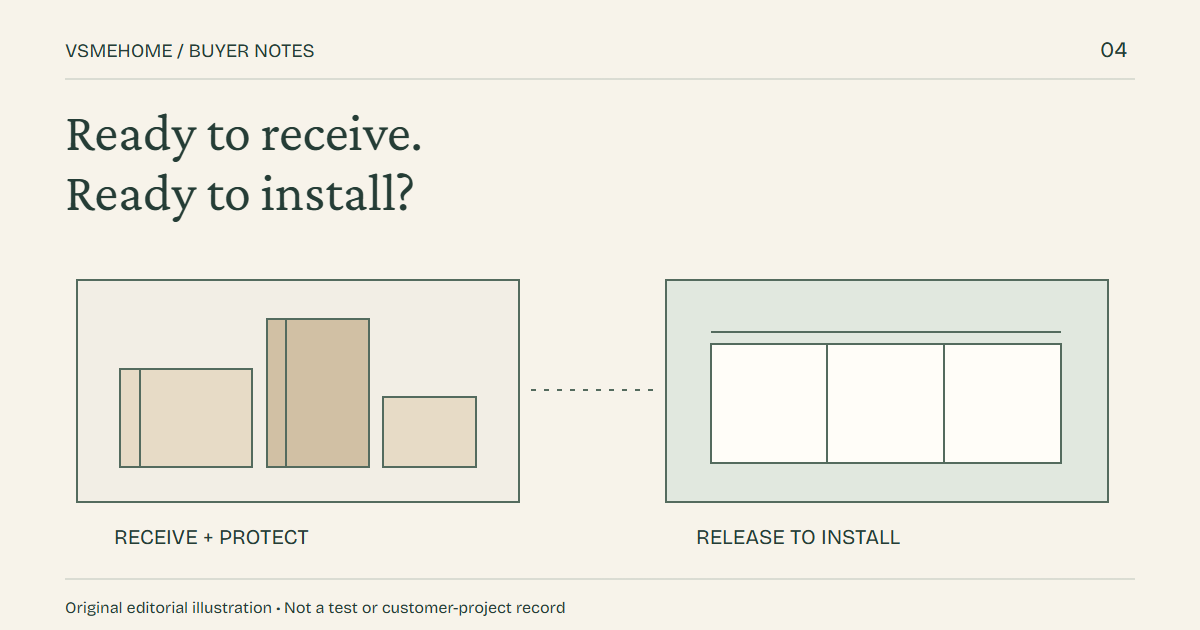
You book an exclusive container (such as a standard 20-foot box). Your cabinets are the only goods inside, and the doors are sealed at the loading site. Instead of trucking that massive metal container onto your suburban street, your freight forwarder or logistics agent directs the container to a local warehouse or freight depot. There, workers destuff the container, transfer the cartons or pallets into a suitable domestic vehicle, and dispatch them directly to your home.
A practical rule of thumb: In its shipping guide, BFP Cabinetry notes that when packed joinery volume approaches around 15 cubic metres (CBM), it is sensible to evaluate a dedicated 20ft container alongside an LCL quote. Similarly, Austone Logistics points out that 15 CBM serves as an operational trigger to request both quotes rather than an automatic commercial break-even point. Depending on package dimensions, weight density, and local depot handling fees, either approach may prove more economical.
Cabinet factories in China typically offer to quote either an origin-based price (such as FOB or FCA) or a delivered price (frequently called DAP or DDP). Neither option is universally superior; each structures control and administrative effort differently.
Under FOB (Free on Board), the factory produces the cabinetry, packages it for export, transports it to the port of departure, and manages export clearance. Ask your appointed forwarder to quote the ocean transport, customs brokerage, depot transfer, and final residential delivery, with the agreed handover point clearly stated.
Under a factory-arranged delivered quote, the supplier books the shipping through their chosen logistics partner, presenting you with a bundled total.
To avoid unexpected expenses upon arrival, ensure every quote you evaluate covers the same scope. When requesting pricing from a cabinet manufacturer or a freight forwarder, use this checklist to verify what is included:
| Cost Category | Factory Delivered Quote (DAP / DDP) | Your Own Forwarder (FOB / FCA) |
|---|---|---|
| Cabinetry & Protective Packing | Included in factory proposal. Verify crate type and packaging specifications. | Included in factory proposal. Confirm FOB terms include loading to vessel. |
| Export Handling & China Customs | Included. | Included under FOB; excluded if goods are quoted EXW (ex-factory). |
| Ocean Freight | Included. Verify whether priced as LCL or dedicated container. | Quoted directly by your freight forwarder based on current market rates. |
| Transit Cargo Insurance | Check whether included and request policy terms, deductible, and coverage details. | Quoted separately by your forwarder or through an independent cargo insurer. |
| Destination Port & Terminal Charges | Must be confirmed in writing. (Often excluded on standard CIF quotes). | Itemized line by line by your forwarder. |
| Import Customs Clearance & Entry | Confirm whether the supplier's agent handles local border filings. | Managed by your licensed domestic customs broker. |
| Import Duties & Taxes (e.g., GST / VAT) | DDP typically includes duty/tax; DAP excludes them. Confirm exact tax responsibility. | Broker calculates duty (checking trade pacts like ChAFTA) and applies import GST. |
| Depot Deconsolidation / Cross-Docking | Confirm whether transferring cartons from the container to a truck is included. | Explicitly quoted for depot unloading and preparation for residential cartage. |
| Residential Final Delivery | Confirm delivery vehicle type (tailgate/tail-lift) and unloading limits (curbside vs. inside). | Quoted based on your specific residential address, vehicle access, and equipment. |
For more on how carton dimensions shape freight costs, see our guide to preparing packed CBM data for freight quotes. To see how these charges add up against a local joinery contract, review China vs. Australian cabinet quotes: finding the unpriced gap.
Custom millwork is built to specific room dimensions, not pulled from warehouse shelving. When an issue occurs, accountability depends on which link in the supply chain caused the problem.
The manufacturer is contractually accountable for building the joinery to your signed production drawings. If a carcass is cut to the wrong width, a door arrives with a factory finish blemish, or hinges are missing from the hardware pack, the factory is your first point of contact.
Before paying a deposit, ask how shortages and defects are handled: does the supplier remake non-conforming parts promptly, and who pays for the replacement freight? A clear after-sales framework is essential, as explored in our guide on overseas cabinet warranty and replacement realities.
Your forwarder coordinates the vessel booking, port paperwork, and overland trucking. If a shipment is held up in transshipment or delayed at the wharf, your forwarder tracks the movement and coordinates with the terminal.
However, forwarders are not automatically liable for transit delays or cargo damage caused by rough weather or sea conditions. Ask about the carrier’s and forwarder’s liability terms and the cargo insurance options available for your shipment.
Marine cargo insurance may cover specified physical loss or damage during transit, subject to the actual cover, exclusions, and deductibles. If a crate is punctured by a forklift or water penetrates the packaging during transport, the insurer reviews the claim.
To support a damage report or insurance claim, preserve all packaging, note visible damage on the driver’s delivery docket before signing, take photos of the crates and damaged panels, and retain the evidence. Review our step-by-step checklist on building an imported cabinet damage evidence file.
A licensed customs broker handles tariff classifications, prepares border declarations, and communicates with government agencies such as customs and biosecurity authorities. If a border hold arises from documentation or tariff classification questions, your broker coordinates the resolution. A broker cannot resolve factory machining disputes or repair broken panels, but they manage border entry compliance.
Different suppliers structure their operations around different buyer needs. Below is our editorial comparison using supplier information read on October 26, 2026. VSME is a brand of Moyisi, the publisher of this comparison.
| Supplier / Brand | Factory Setup & Manufacturing Focus | Residential Order Fit & Logistics Workflow | What to Confirm Before Ordering |
|---|---|---|---|
|
Moyisi / VSME (Publisher Profile) |
Direct joinery manufacturer with a factory of over 10,000 m² in Foshan, producing fitted custom kitchen cabinets, walk-in wardrobes, and bathroom vanities (vsmehome.com | moyisihome.com). | Welcomes single-home residential projects with a published baseline minimum order value of USD $5,000 per order. Standard fabrication runs about 45–55 days after payments reach 50% of the order value. Shipping and installation are additional to production. Ask our team to confirm the shipping scope and coordination needed for your destination. | Confirm verified room dimensions, appliance model dimensions, and local installation arrangements. On-site installation is arranged locally by your trades or quoted separately. |
|
BFP Cabinetry (Cabinet supplier) |
Supplies custom kitchen cabinetry, wardrobe packages, and vanity units for private homes and builder developments (bfpcabinetry.com). | Publishes detailed educational guides explaining FOB, CIF, DDP, container utilization, and transit times. Offers both flat-pack (RTA) and pre-assembled shipping options through logistics partners. | Confirm whether delivered quotes cover destination depot unpacking and residential tail-lift trucking or stop at the local port; check hardware tiers specified in your quote. |
|
George Group (Foshan Chancheng) |
One-stop building materials provider operating an extensive product scope including custom kitchens, wardrobes, doors, windows, and stone surfaces (georgegrouphome.com). | States a 100,000 m² factory footprint in Foshan and showroom infrastructure, catering to buyers who wish to consolidate multiple architectural product categories into a single shipping container. | Clarify which products are fabricated in-house versus consolidated from external suppliers; request an itemized breakdown of destination clearance and handling fees. |
|
Chiffini (Foshan Lecong) |
Custom cabinetmaker located in Lecong's industrial district, focusing on fitted kitchen joinery, painted 2-pack lacquer finishes, and wardrobes (chiffini.com). | Its June 2020 article describes painted 2-pack finishes, solid cabinet backs, and pre-drilled construction for Australian projects. Ask about its current offering. | Confirm the current product scope, suitable materials for your destination, and the delivery and unloading arrangements offered. |
If you are planning to purchase custom cabinetry from China and cannot receive a full shipping container at your home, follow this practical roadmap:
To learn more about our manufacturing background, review our Foshan factory background and ordering facts. If you have preliminary floor plans or photos ready, contact the VSME team to discuss layout options and receive an itemized factory quotation.
Related guide: For the full shipping and customs sequence, see our guide to importing custom cabinets from China.