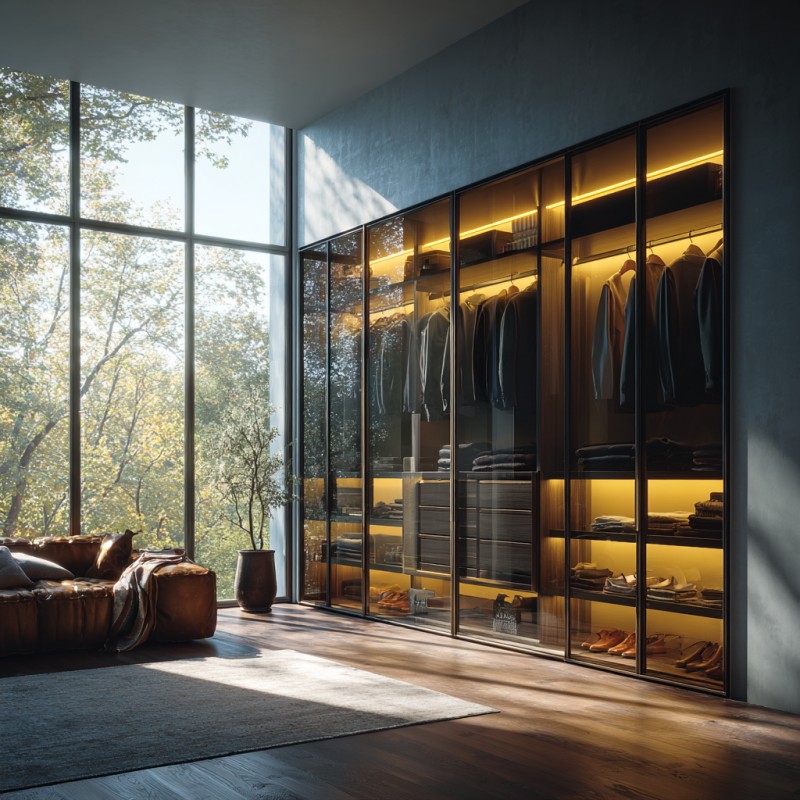
A pull-down wardrobe rail should be selected together with the cabinet opening, doors and intended user's needs. Check the finished internal width, the rail's full movement and the space occupied by hanging clothes before approving the accessory. A mechanism that fits between two panels can still be awkward to reach, obstructed by a hinge or impossible to service once the wardrobe is finished.
Use the clear opening, not the module label
Record the distance between the actual mounting faces after allowing for liners and any required fittings. Ask the cabinet designer to mark that dimension at the rail's mounting zone. Keep the external cabinet width separate: an outside module label does not describe the usable space between finished panels.
For example, Emuca's Sling page for SKU 7030011 specifies a telescopic range of 450–600 mm for the wardrobe's internal space. Other references on that page have different ranges. The example shows why the exact reference belongs on the drawing; it is not a width recommendation for every wardrobe.
Check depth and height as well. Include hangers, the clothes they carry and the handle, not only the metal mechanism. Show any drawer, shelf or storage island below or in front of the rail. The space needed while moving can be different from the space occupied in the stored position.
Check the door relationship through the whole descent
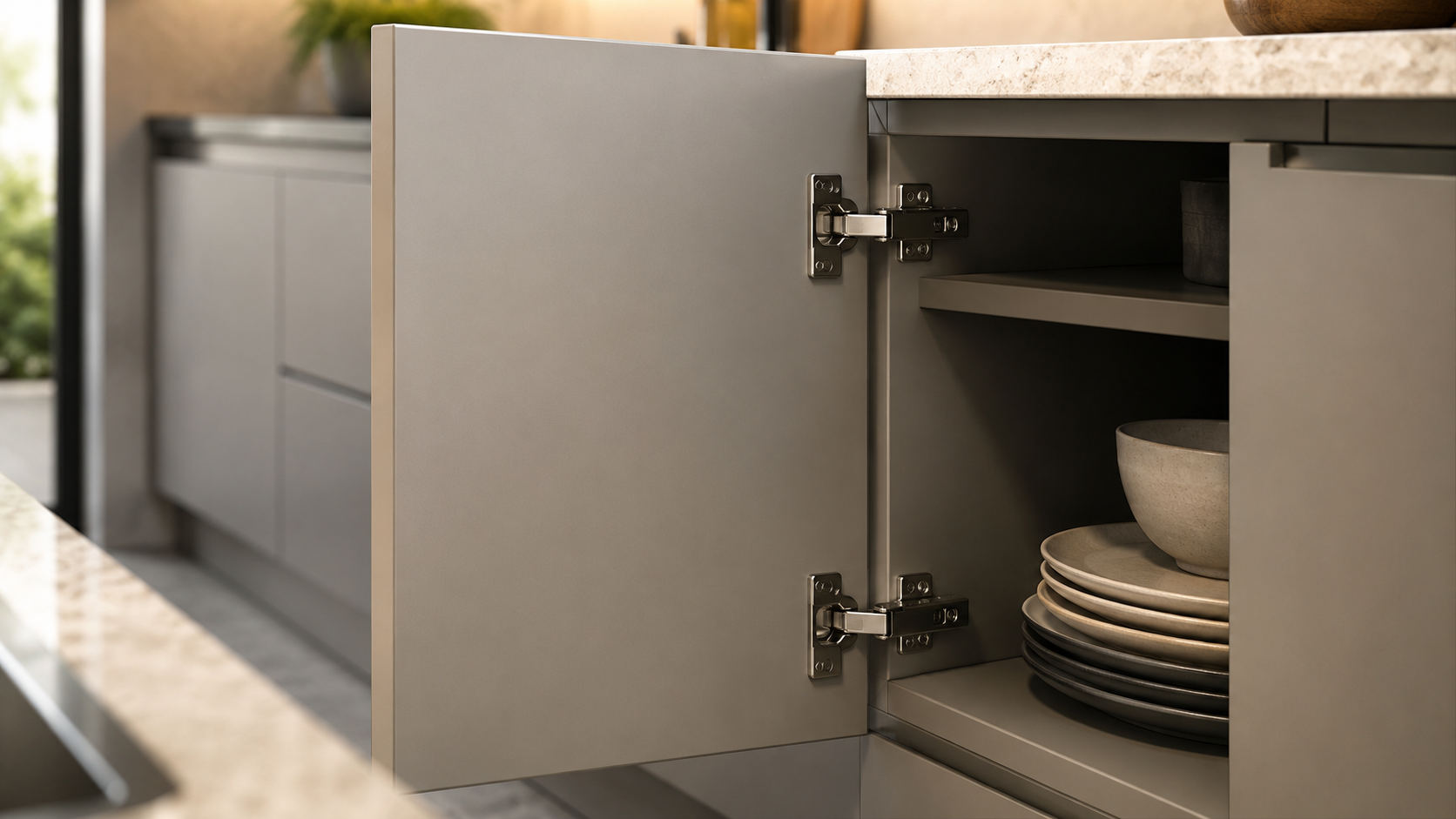
Review the rail in its raised position, partway through its movement and fully lowered. At each stage, check the arms, handle and hanging items against hinges, door edges, handles and adjacent storage. An empty rail clearing a hinge does not establish that a coat on a hanger will clear it.
Servetto's spacer guidance for its 3T lift notes that doors or hinges can obstruct descent and identifies spacers as a system-specific remedy. Do not transfer that accessory or its arrangement to another manufacturer's lift. Ask for the correct solution for the chosen rail and door combination.
If hinged and sliding wardrobe doors are still being compared, use our wardrobe door-access guide to settle the available opening. Then check the pull-down system against that actual opening. A rail selection should not assume access that the finished doors cannot provide.
Separate handle reach from usable operation
A reachable handle is only one part of the decision. Ask the intended user to try the proposed mechanism, where practical, under the supplier's instructions and within its stated limits. Check whether they can begin the movement, access the lowered clothes and return the rail without an awkward position. Do not turn someone else's preferred mounting height into a universal dimension.
Rev-A-Shelf's CPDR series page describes an adjustable telescoping pull rod. That is a useful selection feature, but adjustment alone does not establish suitability for a particular user. Review the handle position alongside the lowered rail, nearby furniture and intended clothing rather than choosing from the product photograph alone.
Keep load information attached to the exact model and its manufacturer's definitions. Ask what the rating covers and how the load should be arranged. Do not convert a stated kilogram or pound limit into an assumed number of coats: the garments and hangers in the actual wardrobe may differ substantially from another household's.
Confirm the mounting and preserve access
Give the supplier the side-panel construction and finished thickness before asking for the fixing detail. The installation drawing should identify mounting positions, the required fixings and any conflicts with shelf connectors or other hardware. Installation must follow the selected manufacturer's instructions; this guide is not a drilling template or permission to substitute screws.
Review how the side mechanisms and their fasteners will be reached after the wardrobe is fitted. A decorative liner or shelf should not silently block an access point that the selected system needs. Ask which cover or component is removed first during service and whether that removal is possible with neighbouring cabinets in place.
Retain the precise model, accessories, installation document and cabinet identifier in the handover file. This is more useful for a future parts enquiry than a general description such as “pull-down wardrobe hanger.” It does not guarantee continued spare-part availability or establish warranty coverage.
Approve the rail as part of the wardrobe
Complete the review with an identified rail, verified internal opening, door arrangement, movement check, mounting detail and user-operation check. List unresolved items before releasing the affected cabinet drawing. If the rail or door hardware changes, recheck those interfaces rather than retaining an approval made for a different combination.
For a VSME wardrobe enquiry, send the internal layout, door preference and intended hanging-storage requirements. Any preferred rail brand, accessory availability and installation scope must be confirmed for the quotation. The manufacturer examples here explain what to verify; they are not claims that VSME supplies every named system.
Source scope reviewed on 7 September 2026. No universal reach height, safe operating load or accessibility compliance is claimed.
We use cookies to offer you a better browsing experience, analyze site traffic and personalize content. By using this site, you agree to our use of cookies. Privacy Policy