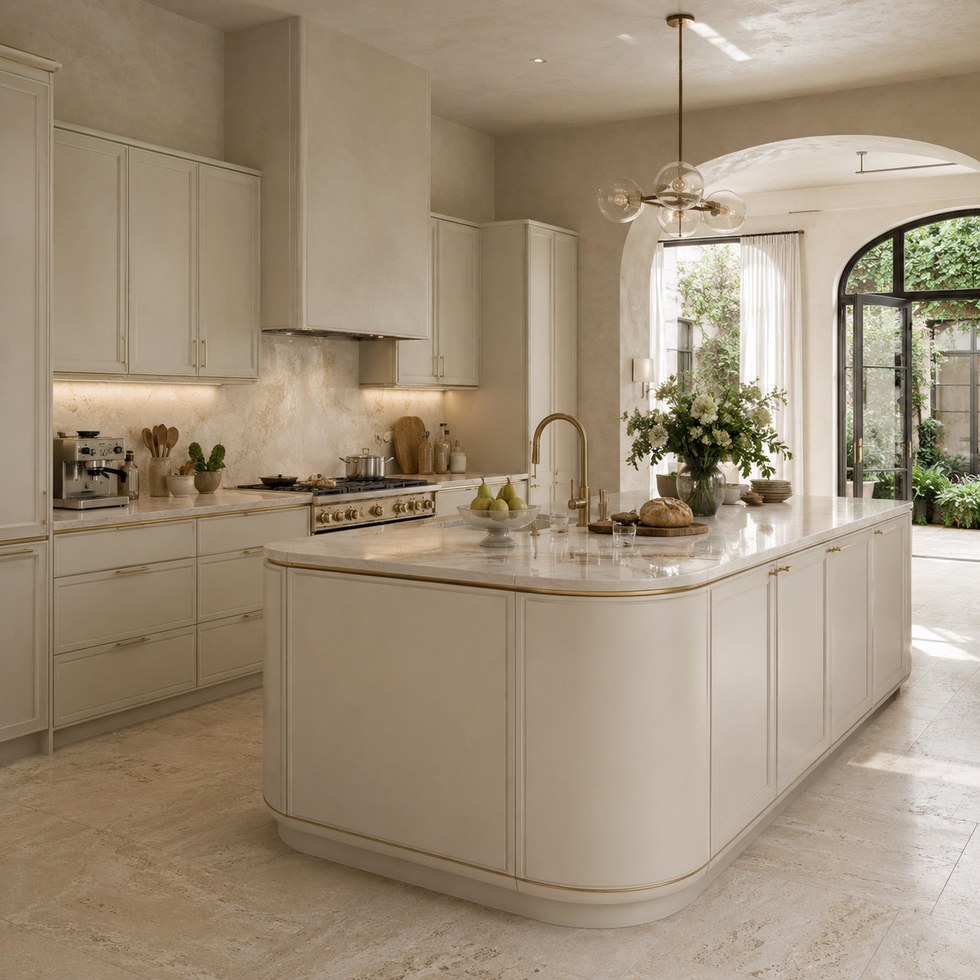
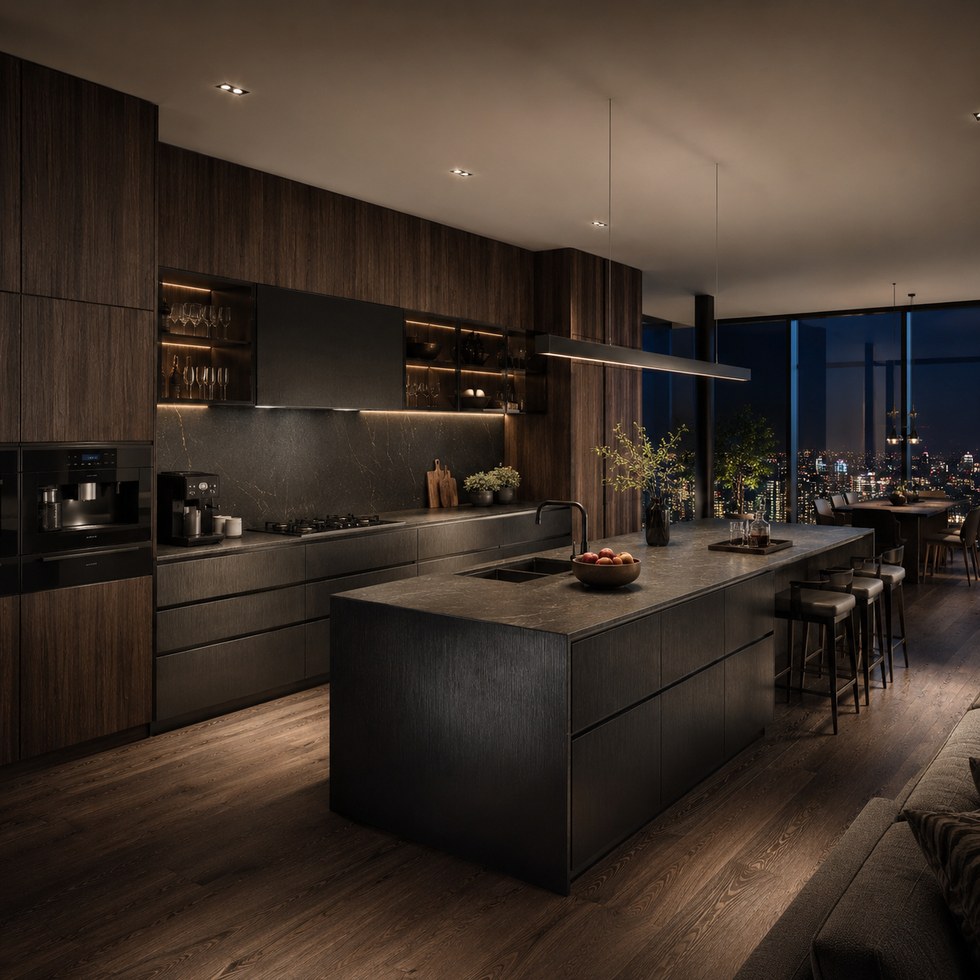
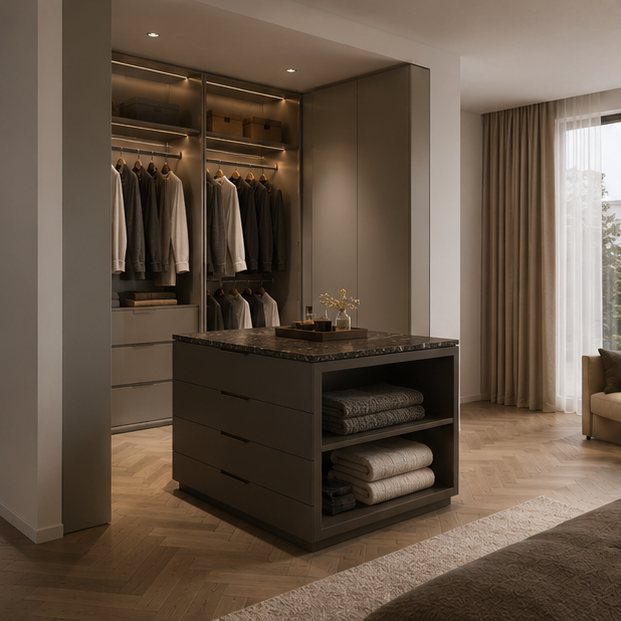
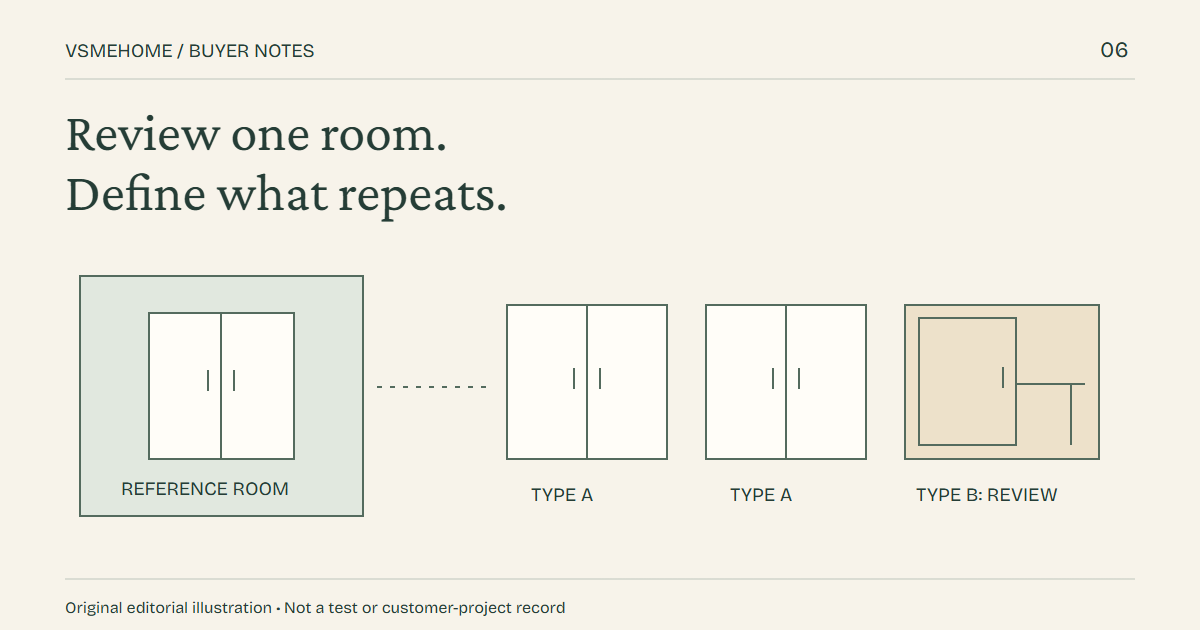
For a natural-veneer cabinet order, approve two things separately: the arrangement of veneer leaves within each face, and the relationship between the finished doors on the elevation. Writing “book-matched walnut” beside a colour sample does not locate the pattern across a wardrobe. Mark the intended groups, direction and order of the fronts, then ask the supplier to confirm the proposed construction and available material.
This guide addresses visual specification before production, not material identification, emissions compliance or a promise that VSME can supply a particular veneer arrangement. The technical sources were reviewed on 7 September 2026.
A leaf match and a door sequence answer different questions
Navy Island's manufacturer guidance distinguishes matching the leaves that form a panel from matching panels across a project. Applied to cabinetry, this means a description of one veneered face is not a complete description of a run of doors.
Start by circling the surfaces that should read together: perhaps a pair of wardrobe doors, a drawer stack or an island end beside its return. Give each visible front an identifier. Use separate groups where the design intentionally changes direction or appearance. The supplier can then discuss an actual arrangement instead of interpreting the word “matching.”
Choose the leaf arrangement without declaring a universal winner
GL Veneer's technical explanation describes book matching as alternating the turned face of successive leaves to create a mirrored relationship; slip matching keeps successive leaves the same way up. Navy Island also describes random matching, using material from different bundles to distribute varying grain characteristics.
Leaf arrangement
Visual intention to discuss
Question that still needs answering
Book match
A mirrored relationship between neighbouring leaves
Where should the centre of that relationship sit on the actual front or group?
Slip match
A repeated directional character without alternating flipped leaves
How will the selected material look across the full width rather than one narrow sample?
Random match
An intentionally varied arrangement rather than a repeating mirror
Which variations are acceptable together, and what would look out of place?
These descriptions are not acceptance grades. Review the actual proposed material and layout. Do not approve a photograph of an unrelated species or a digitally repeated texture as evidence of what a particular natural-veneer set will look like.
Put the visual groups onto the elevation
Consider a hypothetical wardrobe with three tall doors beside a stack of drawers. “Vertical grain throughout” leaves several choices unresolved. The tall doors might form one visual group, while the drawer fronts might each start a new pattern or read together as another group. Neither interpretation is established by the direction arrow alone.
On the drawing, identify the intended group boundaries and label the position of every front. Add grain-direction arrows and show any intended centreline. Ask the supplier to explain how the proposed layout relates to the veneer material and the way the fronts will be made. If the requested appearance is not practical for that proposal, resolve the alternative before treating the elevation as approved.
Do not silently stretch the same instruction around corners. An exposed end, filler, plinth or return may need its own direction and relationship to the main fronts. Identify deliberately different surfaces so that a reviewer does not reject a planned contrast as an error.
Review a set, not just a small colour chip
A small control sample can help identify the selected finish, but it cannot display an entire door sequence. Request a representation appropriate to the decision: identified leaves, a proposed face layout, adjacent representative panels or another agreed review set. Record what is physical, what is a drawing and what remains provisional.
Keep the colour and sheen review alongside the pattern review, not inside it. If appearance changes with viewing conditions, use the separate cabinet finish lighting-discrepancy guide. This page concerns the planned arrangement of the material; it does not diagnose every visible colour difference.
Photograph the proposed set with readable front IDs and a clear indication of its intended orientation. Ask reviewers to refer to the same layout version. A comment such as “second door accepted” is ambiguous if the photograph and elevation number the doors differently.
Protect the approved arrangement through handover
Keep the approved elevation and review-set reference with the front schedule. Ask how the supplier will identify the intended positions for packing and installation. The useful record connects a physical front to its place; it is not simply a second list of finish names.
If a front is replaced or the design changes, reopen the affected visual group for review. Ask whether the proposed replacement should be assessed alone or beside its neighbours. Do not promise an invisible future match, and do not assume that changing the whole group is always necessary. The actual material and the agreed appearance criteria should guide that discussion.
Include four decisions in the enquiry
The proposed veneer and leaf-matching approach, with unconfirmed choices clearly marked.
The identified fronts, grain direction and visual groups on one elevation.
The sample or layout evidence requested for approval, including its limitations.
The method for preserving the arrangement and reviewing a changed or replacement front.
Add this focused appearance brief to the wider cabinet RFQ checklist. When discussing the project with VSME, ask which material, matching and review options can be provided for the actual design. Keep feasibility and price open until the supplier has reviewed that scope.
We use cookies to offer you a better browsing experience, analyze site traffic and personalize content. By using this site, you agree to our use of cookies. Privacy Policy